
Reviewed · HISTORICAL TOURS
Venice: Entrance Ticket to the Naval Historical Museum
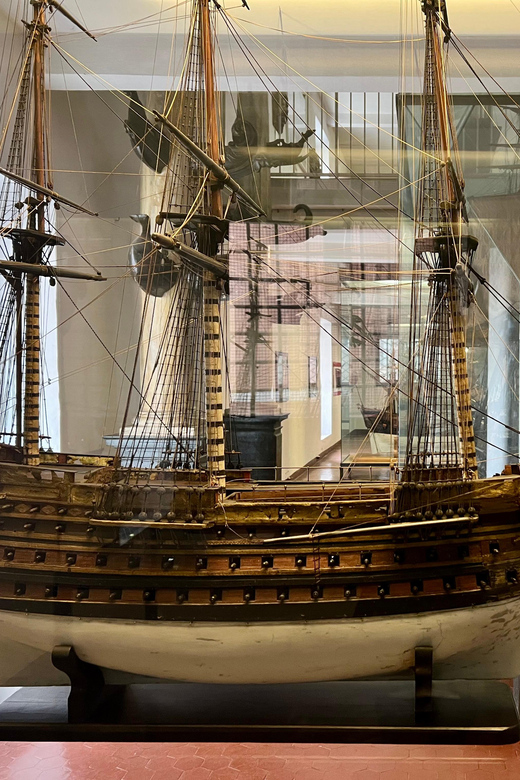
If you like Venice beyond canals, this ticket sends you into the city’s maritime brain. I especially like the big sweep from ancient Venetian boats to modern Italian Navy models, and I also love the standout boats from China and the Far East that show how far Venetian seafaring and curiosity stretched. The only real catch is that this is an artifacts-and-models museum, so if you want lots of hands-on stuff, you may find it a bit still.
I also think the setting helps. MUNAV sits in a 15th-century building (it used to be a granary for the Serenissima) and is a short walk from Piazza San Marco, right by the Ancient Arsenal area. Plan on about 1.5 hours so you can cover the main floors without rushing, even though the museum spreads across five floors and about 6,000 square meters.
Key Things I’d Prioritize at MUNAV
- Far East boat collection: a rare-feeling corner, focused on boats from China and the Far East
- Venice to modern navy timeline: you can trace the story from early vessels to contemporary Italian Navy models
- Museum in a historic naval-era site: a former granary building tied to Venice’s power
- Skip-the-line entry: use the separate entrance so you lose less time outside
- Owned and managed through defense institutions: run by the Italian Navy with Ministry of Defense oversight
- Pets policy is practical: small pets are allowed if in their own carrier or carried in your arms
Venice’s Naval Museum: How It Fits Near San Marco and the Arsenal
MUNAV, the Naval Historical Museum of Venice, is one of those stops that makes sense the moment you get near it. It is only about a 5-minute walk from Piazza San Marco, and it sits close to the Ancient Arsenal of Venice, so you are in the same general neighborhood as the city’s shipbuilding and maritime muscle.
That location is not a detail to ignore. When a museum is physically close to the working heart of the story, it is easier to connect what you see indoors with what you are walking around outside. Venice can feel like it is all about water and pretty façades, but the Arsenal area points you toward the machinery behind the legend.
Also, because this is a ticketed entrance experience with a set time expectation, you can slot it cleanly between other San Marco-area sights. If your day is already packed, the 1.5 hour planning window is a lifesaver.
More museums and galleries in Venice:
- Venice: Leonardo Da Vinci Museum Entrance Ticket
★ 4.5 · 3,560 reviews - Venice’s Best: Basilica, Doge’s Palace, Gondola & History Gallery
★ 4.5 · 2,478 reviews - Venice: Vivaldi’s Four Seasons Concert & Music Museum Visit
★ 4.8 · 2,065 reviews
Ticket Value and Timing: $18 for 1.5 Hours with a Separate Entrance
At $18 per person, this museum is priced in a way that usually feels fair for Venice. You are paying for a focused slice of maritime expertise, not just a room or two, and the museum is big enough to justify taking your time through multiple floors. The ticket is entry only, and that matters, because it shapes how you should pace your visit.
The best practical win is the skip-the-line setup through a separate entrance. Venice lines can be demoralizing, especially if you are walking in from San Marco streets while deciding where to go next. Saving that time helps you keep momentum.
A 1.5-hour duration also sets expectations. You will not read everything cover to cover on five floors, even if you want to. Instead, plan to choose what you care about most, then move briskly through the rest. That way you leave feeling informed, not overwhelmed.
If you like flexibility, the offering includes free cancellation up to 24 hours in advance and a reserve now, pay later option. That is genuinely useful in Venice, where weather and crowds can change your schedule fast.
Entering the Former Granary: What 5 Floors Really Means for Your Visit
MUNAV lives in a 15th-century building that once served as a granary for the Serenissima Republic. That is a great pairing for the subject matter. Venice’s power was not only in ships sailing out, it was also in storage, planning, and logistics that kept fleets supplied and ready.
Inside, you are looking at a museum space spanning about 6,000 square meters with exhibits spread across five floors. For me, that vertical layout is both the good news and the reality check. The good news is variety. You are less likely to feel like you are seeing the same theme repeated in the same way.
The reality check is time. In 1.5 hours, you should not try to cover everything evenly. Instead, think of it as a curated path made by the building and the topics: ship models, paintings, documents, and artifacts across different levels. If you are a careful reader, you may still want to zoom in on the labels and documents most tied to your interests, like navigation history or ship design.
And since there is no guided tour included with the entry ticket, you will rely on the museum’s own signage and display text. That can be totally fine if you enjoy self-paced museum time.
The Main Attractions: Venetian Boats, Ship Models, Paintings, and Documents
The core experience at MUNAV is a maritime story told through objects you can see and compare. You will encounter historical artifacts, ship models, paintings, and documents, and the exhibit themes move from Venice’s early maritime origins toward the modern era.
Here is what I like about this structure. Ship models and documents do not just look interesting, they let you notice design choices and historical details that you might miss with only a lecture or a video. Models are especially good for understanding scale and construction. Paintings can give you an atmosphere or a snapshot of how ships and naval life were viewed. Documents add a grounded, factual layer.
The museum also covers a wide time range, from ancient Venetian boats to contemporary Italian Navy models. That timeline matters. Without it, naval history can feel like a set of disconnected eras. With it, you start to see continuity in purpose, technology, and organization.
One possible downside to plan for is the “museum reading” factor. If you dislike labels and written material, this place may feel slower. If you enjoy learning through displays rather than through a guide’s narration, you will likely enjoy it a lot.
More history-led tours in Venice:
- Venice: City Center Historical Guided Walking Tour
★ 4.2 · 1,873 reviews - Venice: Bell Tower & St Mark’s Square History Gallery Ticket
★ 4.3 · 910 reviews - Basilica, Doge’s Palace, History Gallery & Bell Tower Option
★ 5.0 · 586 reviews - Venice: Natural History Museum Entry Ticket
★ 4.7 · 312 reviews
The Far East Collection I Don’t See Often Elsewhere
One of the most interesting parts of MUNAV is the exceptional collection of boats from China and the Far East. For a Venice-focused museum, that is a smart move, because it expands your mental map of maritime history.
This is the kind of exhibit that can change how you interpret Venice’s role. When you only think about Venice as an Italian trading power, you might assume the story stays within Europe. A strong Far East collection suggests how global sea routes and ship culture could intersect, even when the details are separated by centuries and geography.
Even if you only spend a short amount of time here, it can provide a memorable contrast to the Venetian and Italian Navy material. And because you get both extremes in one museum, you can walk out with a fuller idea of maritime connections and influences.
In 1.5 hours, I’d treat this as a priority stop. If you care about the global angle, it is worth planning your route around it first.
Where the Art and Paper Fit: How to Read Without Getting Tired
MUNAV’s mix of ship models, paintings, and documents is not just decoration. It gives you multiple entry points into the same subject. Some people will gravitate toward the models. Others will like the paintings. And documents help you anchor the visuals to facts.
Since you are going solo with entry only, your strategy matters. I suggest you do this kind of pacing:
- Start with the bigger visuals, like models and paintings, so your brain grabs the topic fast.
- Then slow down for the documents and more detailed artifacts, but only on the labels that answer questions you actually care about.
If you try to read everything on every floor, you will burn time and energy before you reach the sections that interest you most. This museum is large enough to reward smart choices.
Another good approach is to treat each floor like a chapter. Because the museum runs across five floors, the building itself nudges you into segments. You do not need to “finish the museum.” You need to finish the parts you came for.
The Italian Navy Connection: Why Ownership Matters Here
This museum is not a casual city attraction. It is owned by the Italian Navy and connected to Ministry of Defense oversight and management. That relationship shapes the tone of what you see.
What that usually means in practice is a stronger focus on preservation and official material. You are less likely to feel like you are watching a generic maritime slideshow. Instead, you are seeing curated exhibits backed by institutional responsibility.
That matters if you care about accuracy and seriousness. It also helps explain why the museum includes documents and a wide range of models. A naval collection tends to focus on details, not just drama.
You also get a sense of continuity because you can move from earlier Venetian seafaring into modern Italian Navy models. Even if you are not a naval expert, the progression gives you a framework. You start to see that naval history is not only about battles, it is also about technology, organization, and supply chains.
Tips for Seeing MUNAV in 1.5 Hours Without Feeling Rushed
Because this visit is self-paced and limited to about 1.5 hours, I’d plan your route with intention. The museum spans five floors, so your time will evaporate if you wander without a target.
Here is how I would do it:
- Pick one “must-see” theme before you enter. For me, it is the Far East boats plus the timeline connecting Venice to modern Italian Navy models.
- Use the separate entrance to get in fast, then start at the sections that match your interests, not where the crowd happens to be.
- Expect to spend more time where the displays are dense, like model areas and document displays, and less time where you already get the point quickly.
Also, think about your comfort level with reading text. If you enjoy documents and written explanations, you can slow down and still manage the time. If you prefer visual learning, you can skim labels and spend more time with the models and paintings.
One more practical note: you can bring small pets only if they are in a carrier or carried in your arms for the duration of the visit. Guide dogs are exempt. If you are traveling with a pet, plan your movement so you can manage the visit smoothly across multiple floors.
Who Should Book This Naval Museum Ticket?
This is a great fit if you want to understand Venice through its maritime side, not just its postcard side. It works especially well for:
- People who like ship models and design details
- Readers who enjoy documents and historical records in a museum setting
- Visitors who want something directly tied to Venice’s maritime institutions
- Anyone curious about how Venice connects to ships and ideas beyond Italy, especially the China and Far East collection
It is also a smart choice if you want a manageable stop. One ticket, one museum, and a time window of about 1.5 hours. That makes it easier to build into a day around Piazza San Marco and the Arsenal area.
If you are the type who only wants interactive experiences or hands-on activities, you may need to recalibrate expectations. This one is primarily objects: artifacts, models, paintings, and documents. You get depth through viewing and reading.
Should You Book MUNAV? My Take
I’d book MUNAV if you want an informative, Venice-specific stop that goes beyond the usual canal routine. The $18 entry feels like good value when you consider the museum’s scale, its five-floor layout, and the range from ancient Venetian boats to modern Italian Navy models.
I’d also book it if you like museums that feel designed for learning rather than quick entertainment. The Far East boat collection alone gives you a reason to choose this over a more generic sightseeing museum.
Skip it only if your ideal museum day is mostly hands-on activities or you really dislike reading display text. Otherwise, this is a strong choice for a half-day plan that is close to San Marco and still feels different from the city’s main parade of views.
FAQ
How far is MUNAV from Piazza San Marco?
MUNAV is about a 5-minute walk from Piazza San Marco.
How much is the entrance ticket?
The ticket price is listed as $18 per person.
How long should I plan to visit?
Plan for about 1.5 hours.
Is a guided tour included with the ticket?
No. The entry ticket is included, but a guided tour is not included.
Does the ticket include skip-the-line entry?
Yes. You can skip the line through a separate entrance.
What is the museum housed in, and how big is it?
It is housed in a 15th-century building that used to be a granary. The museum covers 6,000 square meters.
How many floors are in the museum exhibits?
The museum offers exhibits across five floors.
What kinds of items will I see inside?
You can expect historical artifacts, ship models, paintings, and documents, covering Venice’s naval tradition from origins to the modern era.
Is there a Far East section or collection?
Yes. The museum includes an exceptional collection of boats from China and the Far East.
Can I cancel for a refund?
Yes, you can cancel up to 24 hours in advance for a full refund.
Are small pets allowed in the museum?
Yes, access is allowed with small pets if they are carried in their own carrier or in arms for the duration of the visit. Guide dogs are exempt.
Recently reviewed around Venice
- Yummy Cooking Class In Venice★ 4.9 · 122 reviews
- VIRTUAL MUSEUM: Creature di Gomma – Venice Vintage Toys★ 4.7 · 3 reviews
- Venice: City Tour & Skip the Line for St. Mark’s Basilica★ 4.1 · 84 reviews
- Your evening in Venice – Legends&Ghosts&Aperitif★ 4.7 · 79 reviews
- Venice: Watercolor Painting Class at the Prisons Palace★ 4.7 · 27 reviews
- Walking Tour to Uncover the Hidden Venice★ 4.4 · 34 reviews
- Wine Tasting in Venice★ 4.6 · 42 reviews
- Venice Walking Tour from St. Mark’s to Rialto Bridge★ 4.5 · 12 reviews
Historical Tours, compared.

Venice’s Best: Basilica, Doge’s Palace, Gondola & History Gallery
Read our review →
Bell Tower & St Mark’s Square History Gallery Ticket
Read our review →
Basilica, Doge’s Palace, History Gallery & Bell Tower Option
Read our review →

St. Mark’s Cathedral Priority Guided Tour & History Gallery
Read our review →
Venice, Submarine Enrico Dandolo and Naval History Museum
Read our review →
Kingly Venice: Doge Palace Ticket, Guided Tour & History Gallery
Read our review →Browse the lists this tour appears in