Reviewed · CITY TOURS
Venice City Escape: “The beggar and the cloak”
Venice gets loud. This experience gets clever. Instead of sitting through yet another walking lecture, you follow a story through the streets of Venice, using an interactive chat on your smartphone to solve riddles and chase clues. The premise is different too: The beggar and the cloak is the kind of plot that makes you pay attention to small details.
I love that it feels like real Venice sightseeing you can control, not a fixed group march. I also like the smart, game-style format that works well for first-timers and families, since you can play at your own pace and stay curious as you walk.
One thing to consider is that you are fully on your own: there is no guide on the ground to clarify confusing riddles, and one small translation snag in English can make clues feel a bit harder than they should be.
Key things to know before you start
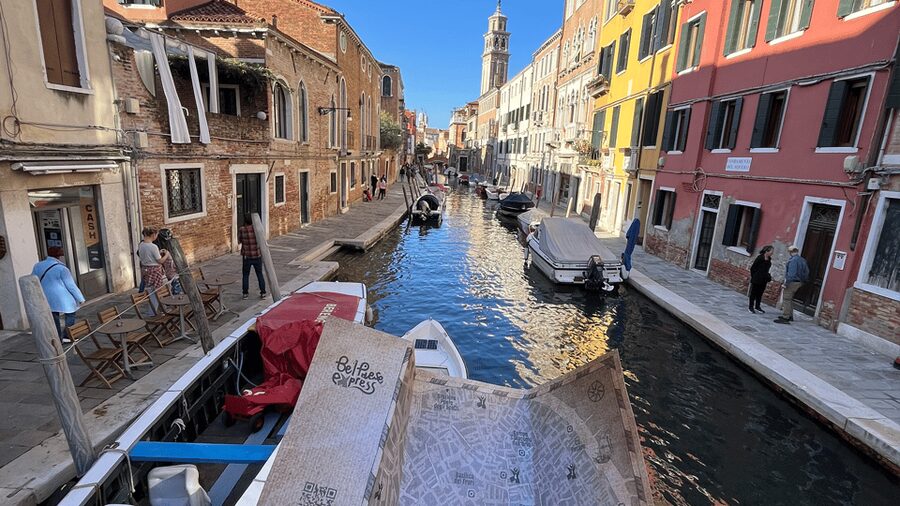
- Smartphone chat, no app needed, with instructions delivered in real time as you walk
- Self-guided route that still feels structured, roughly a 3 km walk over about 2 hours
- Clear Venice start point at Campo Sant’Anzolo, with maps and props provided at the beginning
- A mystery with stakes: find the cloak whose value is tied to coins and jewels
- Available daily except Tuesday, with playing hours from 8:30 am to 9 pm
- Final prize, so you have a goal at the end instead of just wandering
The Cloak Mystery, and why it plays well in Venice
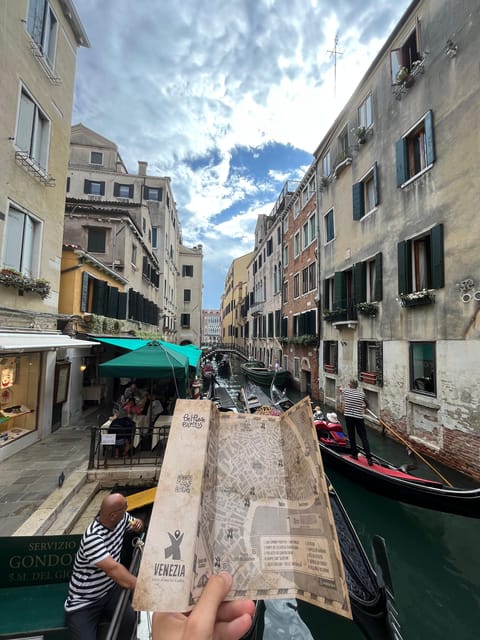
BelPaese Express is built like a city game, not a guided tour. You buy the mission, then you get an access link by email that opens an interactive chat. That chat becomes your “guide,” steering you through stops, asking questions, and nudging you toward the next clue.
The story is also what makes the whole thing click. A desperate gentleman donated an old cloak to a beggar, but the cloak was patched by his mother over her whole life with coins and jewels, so it had hidden worth. Now the fortune is gone, and the location is unknown, so your job is to find it. That kind of plot gives Venice’s alleys and little squares a reason to matter.
If you like sightseeing that asks you to look up, look down, and notice what most people miss, you’ll probably enjoy this. You’re not just passing locations, you’re collecting answers. And because it is designed for all ages, it can work as a low-pressure outing that still feels like an adventure.
More ways to see Venice:
- Venice: City Center Historical Guided Walking Tour
★ 4.2 · 1,873 reviews - Venice: Walking Guided Tour of the City Must-See Sites
★ 4.7 · 1,095 reviews - Venice: Shared Gondola Ride through the Lagoon City
★ 3.9 · 937 reviews
Where the walk actually starts, and how the 3 km route feels
Your mission starts at Campo Sant’Anzolo. From there, you follow the chat’s instructions, piece by piece, across roughly 3 km of walking over about 2 hours. There is no stated time limit for finishing, but your access is valid for a limited window once you activate, so you should plan to play with enough time in your day.
Venice walking can be slippery underfoot and twisty underfoot. The route distance helps you plan realistically, but the best way to think of this is as a steady stroll with frequent pauses. You’ll likely stop more often than you would on a normal walk, because riddles mean reading, comparing, and trying options.
One drawback to flag from real-world experience: a nice map idea can also reveal where you need to go right away. If you’re the kind of person who prefers a mystery that stays mysterious, you might feel the route becomes slightly more obvious once you see it.
How the smartphone chat system works step by step
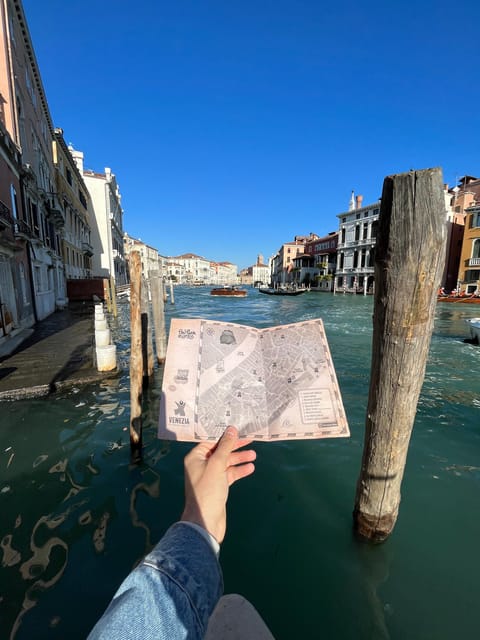
This experience is self-guided, and that changes the “how” in a good way. There is no guide walking with you, so you need a charged phone and internet access for the whole time. The good news is there is no app to download, which keeps friction low.
Here’s the basic flow you can expect:
- After you purchase, you receive an access link by email.
- You open the link and an interactive chat appears.
- The chat guides you through the mission, including when and where to go next.
- You use the included map and any provided props to help solve clues and reach the final section.
- You end with a final prize.
A small practical lesson I learned from how systems like this usually behave: if your email arrives late or you start late, you will lose time immediately. One visitor had an initial email code delay and ended up starting about 30 minutes later, even though the fix was to continue chatting and keep moving. If you want the smooth version, try to start with enough daylight and enough time in your schedule.
The riddles and clues: what you are doing as you walk
The mission is all about riddles to solve, treasures to find, and criminals to catch, in the broad spirit of a classic scavenger hunt. But the real trick is that the clues are embedded in the city. Venice is packed with details, and this format helps you notice them.
You’ll also get mission content that feels cultural, not just playful. Instead of someone explaining history verbally, the chat delivers information connected to what you’re looking at. That can be a relief if you don’t want to stand and listen, and it keeps you moving.
That said, context matters. In English, a visitor noted that translation can be confusing at times, and without prior context it can be harder to interpret what the riddle is asking. If English is your weaker language, you may want to consider playing in Italian or Spanish if the option is available to you. Your goal is to keep momentum, so choose the language that helps you understand the instruction fast.
Hints also deserve a realistic expectation. The idea of hints is good, but one experience was that the hints were not very targeted, which made searching feel broad. If you don’t use hints, it can take longer. If hints are too general, you might still end up scanning more than you want.
My advice: treat hints as a second brain, not as a shortcut. When you ask for help, pause and read the instructions twice before you widen your search. In a crowded Venice corner, that one extra pause saves time.
Same city, a very different kind of day on the water:
- Venice: Doge’s Palace Reserved Entry Ticket
★ 4.6 · 42,716 reviews - Venice: Grand Canal Gondola Ride with App Commentary
★ 4.1 · 18,908 reviews - Boat Trip: Glimpse of Murano, Torcello & Burano Islands
★ 4.3 · 15,699 reviews - Venice: Grand Canal by Gondola with Live Commentary
★ 4.1 · 13,681 reviews
The “secret Venice” effect, and how to make it feel authentic
One of the strongest promises here is discovering secret Venice. You do not get that from a producer’s narration, you get it because a game sends you off the main path and into smaller pockets where you slow down.
That is where Venice magic often happens anyway, and this format nudges you to experience it. You’ll be moving through the kind of lanes where you can hear your own footsteps more clearly, and you’ll have moments to look at details instead of just checking sites off a list.
Because this is a city escape with a narrative, it also changes your behavior. You’re more likely to stand still and study a doorway, a plaque, or a small marker. You’re less likely to rush through because the chat needs you to think.
For first-time visitors, this can be a friendly way to get oriented. Instead of feeling lost, the mission structure gives you a path and questions that keep you engaged.
For repeat visitors, it can still work, because the challenge is not the location, it is the puzzle logic. You might be surprised by how much you notice when the city is your game board.
Timing, availability, and the small rules that affect your day
The mission is available every day except Tuesday, and playing hours run from 8:30 am to 9 pm. You can play any time after you purchase, but you should aim to start with a buffer, because you receive the code within 24 hours of the start of the experience.
There is also a practical suggestion: book at least 2 hours before you intend to play. That doesn’t mean you will always wait, but it protects you from the moment you want to start and your code has not arrived yet.
Your access is valid for 2 hours from first activation. That’s important because Venice can surprise you with detours, crowds, or a slow moment when you are trying to solve something. If you activate late in the evening, you might feel time pressure even if the mission itself does not list a strict countdown.
Maps, props, and why the format can help or frustrate
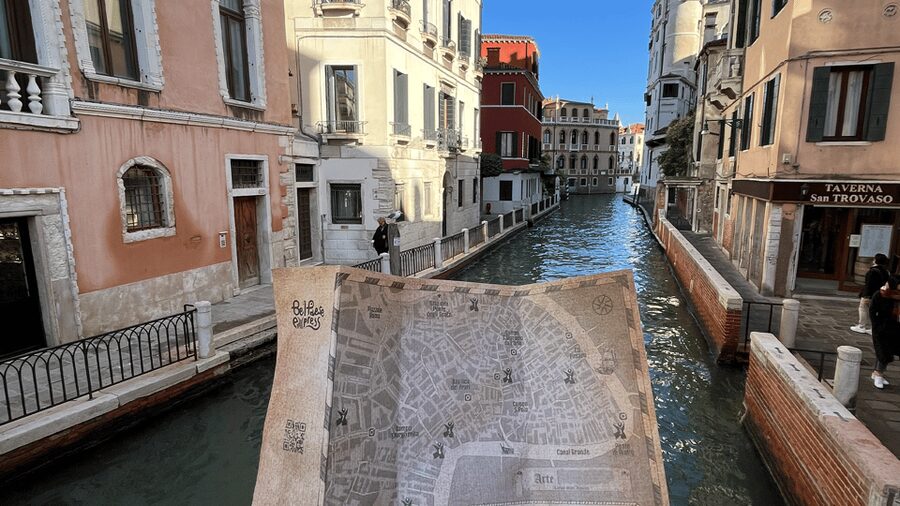
You get a map and props provided at the beginning of the experience. For some people, that is exactly what makes the game work, because it removes uncertainty about where to go next. You also have a clean starting point, Campo Sant’Anzolo, which helps.
But one negative note to keep in mind: if the map reveals the route too clearly, it can reduce the “mystery” feeling. That’s not a dealbreaker, but if you love puzzles where you slowly figure everything out, you might want to treat the map as support rather than a solution sheet.
Props can also be helpful, because they give you something physical to connect with the clue. Even if you do not know Venice well, the game can supply the structure so you are not guessing what you should be looking for.
One more language tip: the mission is available in Italian, English, and Spanish. If your choice is between understanding fast and translating slowly, prioritize understanding. Riddles are only fun when you feel the logic land.
Who should book this, and who might prefer something else
You should book Venice City Escape if you want a different way to see Venice, one that uses your smartphone for guidance and makes walking feel purposeful. It’s especially good if you:
- are traveling with friends and want shared problem solving
- like interactive experiences more than lecture-style sightseeing
- want something that can fit mixed ages
- are visiting for the first time and want a simple way to get oriented
It might not be ideal if you:
- hate self-guided challenges and want a human to explain everything
- are very sensitive to translation issues
- expect hints to be super precise
- prefer completely open-ended wandering instead of a mission structure
Also think about your travel style. If you like to stop often for espresso breaks, build that into your timing. This game works best when you keep moving at a steady pace while you solve, then you reward yourself with breaks between rounds.
Price and value: why $40 for up to 4 can make sense
The price is $40 per group up to 4 people for about 2 hours. That pricing matters because Venice prices can stack up fast, and $40 per group is often a better deal than paying per person for a traditional guided walk.
The value also comes from what you actually get. You’re not just buying access to a map, you’re buying an entire activity structure: a story, an interactive chat system, a route of about 3 km, and a final prize. The smartphone format means you can take breaks and still stay in the experience without waiting for anyone.
If you travel solo, the cost can feel less like a bargain, but it is still a fair way to do an organized activity without committing to a timed group tour. If you have a small group, this is where the math improves quickly.
Final thoughts: should you book Venice City Escape, The beggar and the cloak?
I’d book it if you want Venice with a job to do. The cloak story gives you a strong reason to pay attention, and the smartphone chat turns sightseeing into problem solving without needing to meet anyone or follow a large group.
I would hesitate only if you know you struggle with riddles, dislike hints, or need an in-person guide to interpret information clearly. In that case, consider a traditional guided walk instead, or pick the language that you understand best to reduce confusion.
If you do book, the biggest way to make it succeed is simple: charge your phone, check your start instructions before you leave, and plan for about 2 hours of focused walking plus your own pace stops. Done right, it is a smart, fun way to see Venice that feels like you earned the ending.
FAQ
Where does The beggar and the cloak mission start?
The starting location is Campo Sant’Anzolo.
How long is the experience, and how much walking is involved?
The itinerary is approximately 3 km and takes about 2 hours.
Is there an on-site guide or supervisor with you?
No. The experience is self-guided with no guides or supervisors present.
What do I need to play the game?
You need a charged smartphone and internet access. No application is required.
When can I play this mission?
It is available every day except Tuesday, from 8:30 am to 9 pm.
What is different about paper maps and the reward on December 24, 25, and 26?
On December 24, 25, and 26, the paper map is not available and the reward cannot be physically picked up. You must request the reward via email from the activity provider.
Recently reviewed around Venice
- Yummy Cooking Class In Venice★ 4.9 · 122 reviews
- VIRTUAL MUSEUM: Creature di Gomma – Venice Vintage Toys★ 4.7 · 3 reviews
- Venice: City Tour & Skip the Line for St. Mark’s Basilica★ 4.1 · 84 reviews
- Your evening in Venice – Legends&Ghosts&Aperitif★ 4.7 · 79 reviews
- Venice: Watercolor Painting Class at the Prisons Palace★ 4.7 · 27 reviews
- Walking Tour to Uncover the Hidden Venice★ 4.4 · 34 reviews
- Wine Tasting in Venice★ 4.6 · 42 reviews
- Venice Walking Tour from St. Mark’s to Rialto Bridge★ 4.5 · 12 reviews
City Tours, compared.

Walking Guided Tour of the City Must-See Sites
Read our review →


Winter Pass Top Attractions & City Walking Tour
Read our review →
Venice in a Day: The Main Highlights of the City
Read our review →